Showing posts with label sustainability. Show all posts

Monday, July 23, 2012

Student Work: Cargo Hotel


"....As far back as he could remember, Joey never followed the crowd and always had his own agenda. Rather than participating in the usual school activities, he could typically be found exploring the local train yards. As time passed and Joey grew older he never lost his fascination with alternative life styles. The original passion slowly developed into an exploration of adaptive reuse.

Using recycled shipping containers and old industrial building supply as his main construction materials significantly reduced the start up money required for Joey to put his plan into action. At the same time, the visceral attitude expressed by such deteriorated supplies could potentially allow Joey to make two very bold statements. On the one hand, the containers could be completely remodeled and used to show what bright, luxurious spaces they could be transformed into. On the other hand, container cities could be built out of almost untouched containers, forcing passersby to experience and reflect upon a waste that they indirectly created. "

Thursday, July 19, 2012

Student work : Sustainable Excess


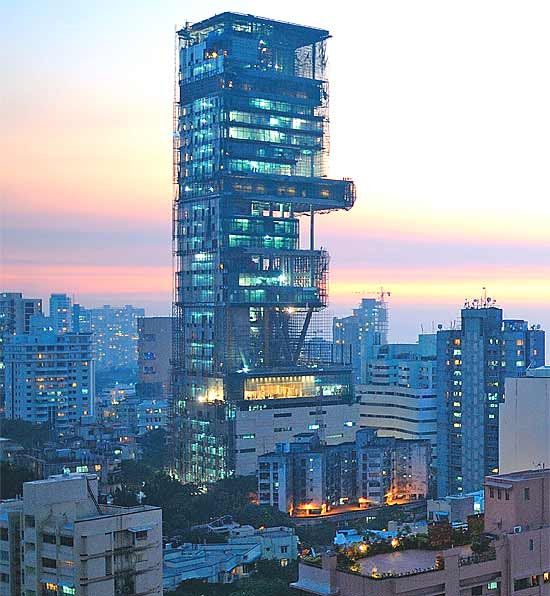
Sustainable architecture is often criticized as having been reduced to "greenwashing".


Pictured is "Antilla", excessively expensive and fundamentally capitalistic, the building justifies itself because of how "green" it is (read "Capitalism: A Ghost Story here). The fundamental motives behind many sustainable design strategies are their non-sustainable contemporaries: luxury, excess, privacy, and denial of mortality. The only difference is a few extra zeroes in the price and a friendly green appearance for the public. Here is one student's response to sustainability:


In defining radicals, punks, and anarchists as the main audience for this piece of sustainability, the project attempts to shed this notion of sustainable excess in favor of something not as pretty but perhaps more apt to shake the foundations of unsustainable design.


The anarchist hotel stretches toward the sun, a precise angle which keeps out the Sun's scorching summer rays while harvesting its fleeting winter warmth. The resemblance to an outstretched middle finger toward the capitalist center of the city may or may not be intentional.


The desired effect of the building promotes non-excessive communal living among urban radicals and flaunts it in the face of the city in a not so status-quo fashion, while shamelessly harvesting its neighbor's waste food and water.


Can the capitalist's definition of luxury exist in a sustainable world? It seems unlikely to this branded consumer. This project by an early architecture student tries to reimagine what luxury might look like - a simple reverence for the sun and the elements along with a deep sense of communal living. Would it actually work in present day Philadelphia? Hell no.

Wednesday, February 15, 2012

Ed Bacon Competition entries

To put it simply, students entering this competition were asked to reimagine Interstate 95, as it runs along the east shore of Philadelphia next to the Delaware River, effectively cutting off the public from the River and its surroundings and creating countless other problems.  Here is how some Temple students responded.


Plug - In

This group, winning the competition's sustainability category, imagines the highway as a source of energy:

Plug-In redesignes I-95 as a generator of electrical energy to nearby homes, businesses and vehicles by harnassing wind, elctro-kinetic, and piezolectric power.


The new I-95 will supply electricity to the parks and walking districts above it, as well as cover 50% of the elctric cost to those who wat to build on the vacant/underused lots of the area.
- by Melhissa Carmona, Noelle Charles, Amanda Mazid.

The Death and Life of Great American Highways

Here's a group who proposed leaving the Highway to rot:

Historical studies reveal a pattern of death and life - pavement taking over forest, retail rising out of industry, highways emerging out of railroad ruins... the pattern will continue ad infinitum. The highway typology will see its imminent death with the decline of oil production. Any infrastructure linked to the highway and oil use will die off: parking lots will become increasingly vacant, big box retail will decline as importing becomes scarcer, and also areas of the city will be swallowed by the rising waters of the Delaware. The city will soon search for a new way of living in the ashes of the obsolete past.


Various magnitudes of 'cracks' exist in the area. Our proposals will strengthen and expand these cracks, allowing natural forces and multifunctional elements to seep through, thus revitalizing dead infrastructure with diversity of function.


A new I-95 will be obsolete in as little as 40 years, and is therefore a waste of the city's funds. The current I-95 will be repaired as it is, with minor adjustments that will urge the highway to decay gracefully. As traffic volum decreases, natural elements (trees, streams, wetlands) will appear in cracked areas.


Differing sections of the decayed I-95 will include: freshwater reservoir, wetlands (providing water filtration). young and old forests, farmlands, hills, recreational areas, and shelters for the environmentally displaced.

- by Carolina Giraldo, Ian Sauls, Brandon Youndt.